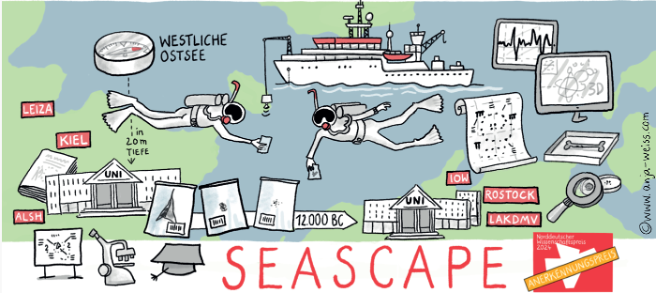
In the north of Germany, a rich archaeological record is present of Paleolithic and Mesolithic sites. The most notable examples being the Ahrensburg tunnel valley, where large-scale hunting activities of reindeer took place, and the ancient lake of Duvensee, with evidence of a long-term settlement of Mesolithic people. Sea-level rise during the early Holocene has resulted in the submergence of extensive areas of this landscape beneath the Baltic Sea.
With a long history of studying submerged prehistoric sites in Northern Germany, several new research projects have been initiated in recent years. Among these is the investigation of the Blinkerwall, the focus of our project (SEASCAPE). The study of the ‘Blinkerwall’ offers a unique opportunity to understand the traditions, subsistence strategies, mobility patterns, hunting strategies and territorial developments of the first hunter-gatherers to follow the retreating ice sheets in northern Europe. However, due to its depth, size and lack of comparable studies in the Baltic Sea, archaeological field work is challenging and interpretation uncertain.
In order to better understand how to interpret the function of the newly discovered structures of larger scale in the Baltic Sea, comparable features from prehistoric and sub-recent times are to be evaluated and comparatively analysed using quantitative as well as qualitative data sets. A review of existing structures is essential for a solid scientific interpretation of the Blinkerwall and comparable structures which might exist elsewhere in the western and southern Baltic Sea.
Challenges are not limited to the deeper located sites. Research at the Conventer Niederung revealed to us a new range of complications. The site is located in four distinct zones: terrestrial peatland used for agriculture, beach, shallow water until 2 meters and the deeper waters reaching from 2 to 12 meters in depth. All zones contain archaeological material of which the dating is uncertain, but all origin from the same archaeological culture. Due to the different zones on this site, one main research approach is not possible and revising our strategies is essential. In addition, collaborative efforts with researchers from the Leibniz Institute for Baltic Sea Research (IOW) and the SUBNORDICA project aim to quantify peat erosion at the site. Given the good preservation conditions of archaeological remains in peat, the rapid loss of these deposits is of significant concern.
The Blinkerwall and Conventer Niederung exemplify the technical and scientific challenges inherent to research on submerged and complex prehistoric sites. Together, they highlight the need for innovative methodologies, workflows and interdisciplinary collaboration to advance our understanding of early hunter-gatherer societies in northern Germany.
Meeting-ID: 891 3799 2173 Kenncode: 275523
Teilnahme über den Internet-Browser: https://zoom.us/join
https://us06web.zoom.us/j/89137992173?pwd=uBrkafkn0dxmXzshTcdjCSb9xusmpJ.1
Teilnahme über Zoom: